A First Visit to a Community Ceremony: What to Notice
A first visit to a community ceremony is easier to follow when you notice its sequence, roles, repeated gestures, and cues without guessing at belief.
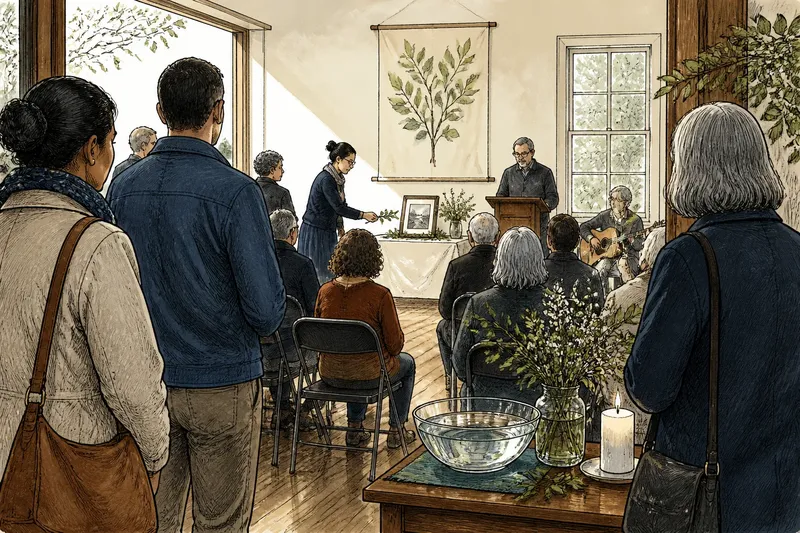
You arrive at a community hall just as a bell sounds, and the people near the doorway turn toward a small table at the front. At a first visit to a community ceremony, you do not need to know every name or meaning to follow what is happening. Start by noticing the sequence, the roles people take, and the gestures that return.
What should I notice first at a community ceremony?
Notice how the gathering changes from arrival to attention. People may chat as they enter, find places to stand or sit, and then respond to a spoken welcome, a musical cue, a bell, or a pause. That shift helps you see where the ceremony begins, even if no one announces a formal opening.
Keep your attention on what is observable: who moves, what happens next, and how others respond. A wreath may be placed, a name may be read aloud, or a group may turn toward a speaker. Those details are useful without requiring you to infer what anyone privately believes.
A small notebook can help if you are there to learn, but taking notes should not distract from the gathering. Write down a few short observations afterward rather than recording people or interrupting a quiet moment. If photography is allowed, follow the host’s directions and avoid treating permission to take pictures as permission to capture every participant.
How can I follow the ceremony’s sequence?
Think in terms of transitions rather than a fixed script. A ceremony may move from welcome to remembrance, from a reading to a shared action, or from a formal moment back into conversation. Pay attention to what signals each transition: a change in music, a person stepping forward, a pause, or the group’s movement.
Notice whether actions happen once or return. A short phrase may be spoken at the beginning and repeated later; a procession may pass the same place on its way in and out. Repetition gives the event a shape, but it does not, by itself, reveal a single meaning.
Say you attend a neighborhood gathering where a host welcomes everyone, a volunteer places a small branch beside a photograph, and the group falls quiet before a song. You could note that the sequence moves from welcome to an object being placed to shared silence and music. That account stays close to what you saw, without claiming to know why each participant found the moment meaningful.
Who has which role during the gathering?
Look for roles through action, not appearance. One person may welcome arrivals, another may guide a procession, and someone else may read names or care for objects used in the event. A role can be formal, such as a designated speaker, or practical, such as a volunteer indicating where people can gather.
Notice how the roles connect. Does one person begin an action that others take up? Does a speaker hand an object to someone else, or does the group respond together after a cue? These relationships show how the ceremony is carried out collectively, even when one person is visibly leading.
Try not to assume that the most prominent speaker represents everyone present. Participants may have different relationships to the occasion, and some may take part by listening, arranging a space, or choosing not to join a particular gesture. Describing what each person does is more respectful than assigning them a motive.
What do repeated gestures tell me?
Repeated gestures can help you recognize the ceremony’s rhythm. People might stand at a particular moment, bow their heads, pass an object, lay flowers, or answer a spoken line. Watch for whether the action is invited, modeled by a leader, or taken up spontaneously by some of the group.
Also notice who participates and who does not, without treating either choice as a statement you can decode. A person may remain seated because of access needs, personal preference, or a reason you cannot see. The most careful observation is simply that the gesture happened and that participation varied.
When you describe a gesture later, use concrete verbs: “the group stood,” “the speaker opened a folded paper,” or “several people placed flowers.” Avoid turning an observation into a claim about what the gesture must mean. If someone explains its significance publicly, you can attribute that explanation to the speaker rather than presenting it as universal.
How should I take part if I do not know the customs?
Follow the host’s instructions and the practical cues around you. If people are asked to stand, join only if you are comfortable; if the invitation is unclear, remaining still and attentive is usually less disruptive than copying a gesture without understanding whether participation is expected. You can also ask an organizer beforehand whether visitors are welcome to take part in particular moments.
Dress and arrival customs may depend on the event and venue. Check any invitation or public notice, and if it says little, choose ordinary, respectful clothing suited to the setting. Arriving quietly, keeping a clear path open, and silencing your phone are simple ways to avoid drawing attention away from the gathering.
If a ceremony includes a practice you do not wish to join, you can observe quietly. You do not need to perform an unfamiliar action to show respect, and you do not need to explain your choice to the whole room. Local custom and the organizer’s guidance can clarify what is expected of visitors.
What can I ask afterward without prying?
Ask about the public structure of the event rather than another person’s private reasons for attending. For example, you might ask an organizer, “Is this part repeated at every gathering?” or “Who usually helps prepare the space?” Such questions invite context about how the ceremony is organized and maintained.
For a question about a symbol or gesture, leave room for more than one answer. You could ask, “Would you be comfortable telling me what the group’s explanation of that gesture is?” The person may offer a public account, explain that meanings differ, or prefer not to discuss it. Accept the answer without pressing for personal belief.
Say you notice a bowl of water beside the entrance and wonder whether it is part of the ceremony or simply there for guests. Asking a volunteer where it fits in the event’s sequence is a focused, practical question; asking a stranger what the bowl means to them may feel more personal. The first question seeks public context without assuming that one explanation applies to everyone.
How can I describe the ceremony afterward?
Separate the order of events from your interpretation. A clear account might say that the gathering opened with a welcome, a speaker read several names, and attendees then placed flowers near a photograph. If you add your own response, mark it as yours rather than assigning it to the group.
Use care with images and names, especially if the event is intimate or includes people who may not expect to be featured publicly. Follow any stated photography guidance, and consider whether a detail is necessary to explain what happened. A description can convey the ceremony’s sequence without identifying individual attendees.
A first visit to a community ceremony becomes easier to understand when you track transitions, roles, and repeated gestures while leaving private belief open. That approach gives you a grounded account of what the group did together—and a respectful reason to ask about the parts you still do not understand.