Before the Noticeboard: How Public Notices Found Their Form
Public notices took shape through routines of speaking, posting, and sorting. See how their format helps shared information reach readers and stay clear.
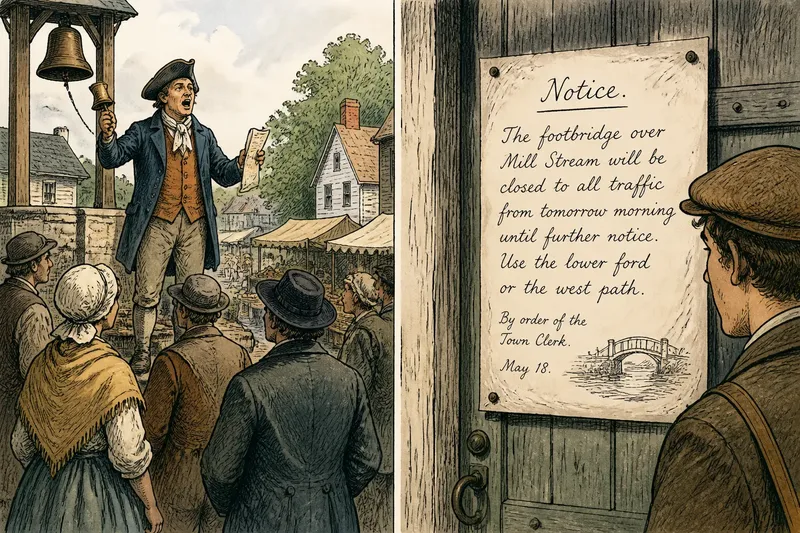
A bell rings near the market, and a few minutes later a handwritten sheet appears on a doorway. One message travels by voice; the other stays put for passersby. Public notices are easier to understand when we look at these choices of audience, place, wording, and visibility—not as a single documented history, but as parts of civic communication.
Imagine a fictional town using both spoken announcements and posted notices during an ordinary week. The scenes below are an illustrative model, not a record of how notices developed in any particular place. They show how different formats can shape who encounters information and what remains available afterward.
Spoken public notices depend on who is listening
Imagine a town meeting called after a bell sounds near a market. A messenger says that a footbridge will close the next morning. People nearby hear the words; someone arriving later may hear only a fragment from a neighbor.
A speaker can repeat a time, answer a question, or explain an unfamiliar place name. Yet the message depends on attention and memory, and listeners may carry different versions away. In this fictional scene, the announcement reaches people who recognize the signal and can come within earshot.
That makes the audience part of the message. Someone must have permission or authority to speak, and listeners must be able to encounter the announcement. The same is true today when a community meeting, transit announcement, or public-address system reaches some people more readily than others.
A posted public notice gives readers another chance
In the imagined town, someone writes the bridge closure on a sheet and fixes it to the meeting-house door. A passerby can stop, read it twice, and tell a person who missed the announcement. The paper gives the message a point of return.
But a notice is not public to everyone simply because it is posted. Its reach depends on where people can approach it and whether they can read and understand it. A sheet inside a locked building serves a narrower audience than one facing a well-used path; cramped handwriting can make either hard to use.
Placement also signals whom the notice expects to reach. A doorway catches people entering, while a crossroads may meet people already on their way elsewhere. The location helps shape which matters become visible as shared concerns.
Headings and dates help readers scan a noticeboard
Suppose several fictional sheets accumulate on one door: a meeting time, a lost parcel, a road closure, and a request for volunteers. A passerby scanning the wall may notice the largest writing first, while a short note tucked behind another sheet may be missed.
Headings give the eye a place to begin. Dates help distinguish current information from old sheets, and separate notices keep unrelated messages from blending together. A consistent arrangement can help readers know where to look next time.
For a notice read between errands, useful cues include who issued it, what action it requests, and when that action applies. If those details are buried in a paragraph, a reader may have to stop and study the sheet rather than understand it at a glance.
Repeated notices can support memory without becoming clutter
In the fictional week, imagine a clerk replacing the first bridge notice with a clearer sheet that names the closure period and an alternate route. The new version gives people another chance to encounter the message. Repetition can make information easier to notice, but only if readers can tell which version is current.
A date, a removal routine, or a heading such as “Current notices” can signal what still applies. If old information remains beside new directions without explanation, the wall becomes an accidental archive and readers have to guess.
When a sheet comes down, some people may still remember its instruction because they encountered it more than once or connected it with a familiar landmark. The paper does not preserve every conversation around it, but repeated display can help a short message enter local memory.
Standard forms make the speaker and the message visible
In this imagined town, a clerk uses the same layout for each official notice: the issuing office at the top, a concise subject line, a date, and a plain-language instruction. Readers can recognize a familiar format before studying the details.
A town office’s name makes a different claim from an unsigned sheet, even if both use similar handwriting. The format identifies who is speaking; the wording tells readers what that speaker expects. This distinction matters for civic trust and for deciding where to ask questions.
Standard forms also involve a tradeoff. A tidy layout can make official directions easy to scan, yet leave little room for local requests, uncertainty, or disagreement. A display’s arrangement influences which voices appear together and which remain separate.
A simple observation can show how a noticeboard guides attention
Imagine you want to describe the noticeboard at a fictional community center. Your starting point is one visible board; you visit it on several days during a week and jot down only public details about placement, wording, dates, and changes. The expected result is a short account of what readers can find quickly and what may be easy to miss—not a historical claim about how notices first developed.
- Check the location: note whether the board faces a path, sits behind glass, or requires entering the building. If passersby can stop and read it, describe who can approach; otherwise, note that access is limited and consider which other public location would reach them.
- Check the headings: look for labels that distinguish events, services, warnings, and requests. If readers can identify topics without reading every sheet, describe how the labels help; if not, note which messages are hard to sort and suggest clearer headings.
- Check dates and authorship: look for a posting date and the name of the responsible person or organization. If both are clear, note that readers can judge currency and source; if either is missing, mark that uncertainty and avoid treating the notice as current or official.
- Check visual order: observe whether size, placement, color, or grouping draws attention to some messages first. If an urgent or time-sensitive notice stands out, describe the cue; if unrelated sheets compete for attention, note that grouping or a stronger heading could help.
- Check for changes on a later visit: see whether old notices are removed, updated, or left beside newer ones. If outdated sheets are cleared or marked, describe the board as easier to interpret; if they remain without explanation, say that readers may not know which information still applies.
- Check privacy before recording: look for names, phone numbers, or other personal details. If a note contains them, do not copy or photograph those details; if it contains only general public information, record a brief description without turning someone’s message into an exhibit.
Keep your notes modest and focused on the display’s public function. If you need to document personal information for a legitimate reason, ask permission rather than copying it casually.
Readers compare public notices and announcements in different ways
What is the difference between a public announcement and a public notice?
An announcement is usually delivered aloud or through a live channel, so people receive it at a particular moment. A notice remains available to read later, though its usefulness still depends on where it is displayed and how clearly it is written.
Why do public notices use dates and headings?
Dates help readers judge whether information is still current, while headings make it easier to find a subject quickly. Together, they help turn a sheet of text into something a passerby can scan and revisit.
Where should a community notice be posted?
The right location depends on whom the message needs to reach and where those readers can comfortably pause. A library entrance may suit a service update, while a transit stop may make a route change easier for riders to encounter.
How can a notice be easier to remember?
Use a clear subject, familiar place names, a specific action, and a date readers can recognize. Repeated display in a dependable location can help people connect the message with an everyday route.
Public notices connect a format with civic memory
The imagined change from spoken announcements to posted notices is not offered as a universal history. It illustrates how information can wait for its audience, be revisited, sorted, and associated with an institution or place. A bell gathers listeners briefly; a sheet offers another encounter; an organized display helps readers decide where to look.
When you pass a noticeboard, look beyond the words to the choices that made them visible: its placement, heading, date, and neighbors. Public notices can enter civic memory when a shared format helps people encounter the same information, recognize its source, and carry its meaning into conversation.