Plaque, Marker or Memorial Stone?
Plaque, marker or memorial stone? See how each form presents public memory, carries context and shapes visitors’ attention so you can choose a fitting approach.
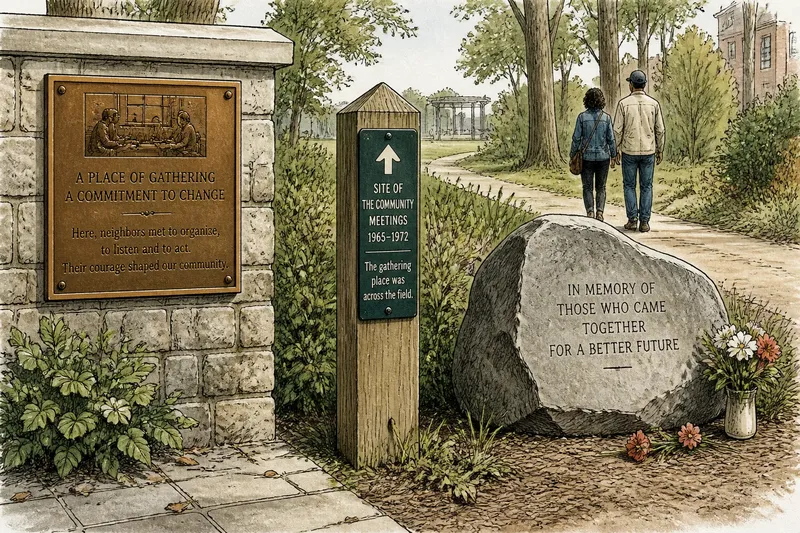
At a path junction, a bronze plaque catches the light; a low stone sits beside the grass; a post points toward a site just beyond the trees. Each might commemorate the same event, yet each asks a passerby to notice something different. Choosing a plaque, marker or memorial stone is a choice about what public memory should make visible.
The distinctions are not absolute. A marker can carry an inscription, and a stone can hold a plaque. Still, their usual forms offer useful ways to think about visibility, context and attention.
A plaque brings words close to the viewer
A plaque is a surface made for reading. Fixed to a wall, railing or pedestal, it brings names, dates and a short account into a compact space. Its strongest feature is legibility: a visitor can approach, pause and read without first understanding a larger landscape.
That intimacy suits commemoration centered on specific people or an event with a concise account. A plaque can name those remembered and explain why the spot matters. Its edges also impose a limit. Long explanations become dense, while unfamiliar names or references may leave readers with questions the object cannot answer.
Placement shapes the experience. A plaque at eye level on a busy entrance may be easy to find but difficult to read amid movement. One set just off a path can invite a quieter pause, provided it remains visible and accessible. The surface should face the people expected to encounter it, not merely the person who selected the wall.
A marker ties commemoration to a location
A marker often works like a pointer: it signals that a place, route or feature carries meaning. It might stand beside a former meeting place, mark the edge of a historic site or identify a path associated with a local story. The object can be modest because the location supplies part of the message.
This is its particular strength. A marker can help visitors notice a relationship between a remembered event and the ground around them. Instead of drawing attention only to an inscription, it directs the eye outward—to a bend in a road, a riverbank or the outline of a building.
The trade-off is that location alone does not explain much. A marker passed at walking speed may register as a sign without giving anyone a reason to stop. A few carefully chosen words can establish what is being remembered and where to find fuller context, such as a nearby interpretive panel or a locally maintained website. If the site has changed, the marker can clarify what remains visible and what is no longer there.
A memorial stone gives remembrance a physical presence
A memorial stone makes material itself part of the encounter. Its weight, texture and relation to the ground can suggest endurance, gathering or quiet regard without explaining those ideas in words. People may approach it, sit nearby or leave flowers, depending on its form and setting.
That openness can welcome different kinds of attention, but it also leaves more interpretation to visitors. A plain stone may be moving to someone who knows its story and puzzling to someone who does not. An inscription can provide a point of entry, though adding text shifts some of the burden back toward naming and explanation.
Stones also alter their surroundings in a way a small plate may not. A large block can become a focal point, while a low stone can belong to the landscape more quietly. The right scale depends on how people use the site and whether the object should be approached as a destination, encountered along the way or noticed from a distance.
The three forms distribute context differently
Think of context as the information a visitor needs to understand what is being remembered. A plaque can carry a compact account directly on its face. A marker can rely on its position, with a brief inscription orienting the reader. A memorial stone can communicate through material and presence, while leaving names and explanation to an inscription or nearby source.
Imagine a neighborhood wants to commemorate a former gathering place where a community organized for change. If the main aim is to name those involved and explain the event in a few lines, a plaque by the entrance may serve that purpose. If the aim is to help people recognize the exact corner where gatherings took place, a marker tied to that location may speak more clearly. If residents want a place for quiet remembrance that does not prescribe a single response, a stone could provide that focus, with separate interpretation available for visitors seeking detail.
In each case, the visible object is only part of the message. The wording, placement and relationship to the surrounding place determine whether a passerby can connect the object to the people or events it commemorates.
Choose by the attention the place can hold
Before choosing a form, consider what a visitor is likely to be doing there. Someone crossing a transit plaza may have time to notice a clear marker but little chance to read a dense inscription. In a garden or along a quiet path, a stone may invite a pause. At a building entrance, a plaque can make names and explanation available at close range.
Use these checks to connect what you observe at the site to a practical choice:
- What should be visible first? If visitors need to recognize names, choose a form with readable text; if they need to find a particular location, favor a marker oriented toward it.
- How much context must the object carry? If visitors need a concise account, allow room for an inscription; if a nearby panel or website can provide detail, keep the object’s text focused.
- Will people have room to stop? If foot traffic and access allow a pause, a plaque or stone may invite closer attention; if people mostly pass through, favor a visible marker with brief wording.
- Who is likely to recognize the references? If visitors may not know local names or history, include plain context; if the object serves a familiar community gathering place, concise wording may be enough.
- How will people encounter the object over time? If surroundings may change, make the location and story clear in the inscription; if the setting is stable and self-explanatory, a simpler object may suffice.
- Can visitors approach and read it comfortably? If the surface is visible and reachable from the path, retain that placement; if plants, traffic or barriers obstruct it, choose a clearer position or a different form.
Say a library wants to remember volunteers who kept a neighborhood reading room open during a difficult period. In this invented situation, the starting point is a changed building entrance, a short verified list of volunteers, and a community preference for making the former room’s location easy to recognize. First, the organizers identify the old room’s position on a site plan and confirm which names belong on the public text. Next, they compare a plaque at the current entrance with a marker at the former room’s location: the plaque would make the names easy to read but might blur where the room was, while the marker would point to that spot but leave limited room for names. They choose the marker for location, then place the names and a brief account on an accessible panel beside it. The observable result is that a visitor can identify the former room and find the people being remembered without asking one object to do both jobs.
Which form fits the place and the memory?
Can a plaque be part of a memorial stone?
Yes. A plaque can add names or explanation to a stone whose material presence carries a separate meaning. The combination works best when the text is easy to find and feels integral to the design.
Is a marker always a sign?
No. It may be a post, a small stone or another object that identifies a meaningful location. What makes it a marker is its relationship to the place it points out, not a single material or shape.
Which form carries the most context?
A plaque usually has the clearest space for a concise written account. A marker can add orientation, while a memorial stone often communicates more through presence than explanation.
Can one object serve all three purposes?
It can combine them, but each role should remain legible: the object should identify what is remembered, connect it to a place and offer an appropriate setting for attention. If those functions compete, a small, coherent group of objects may communicate more clearly than one overloaded form.
For a public commemoration, the best choice is the form that lets visitors meet the memory in the way the place can support. A plaque makes language immediate, a marker makes location meaningful and a memorial stone gives remembrance a tangible presence. Before settling on one, look at the site from a passerby’s approach; what they notice first may matter as much as the inscription.