The Myth of the One Meaningful Monument
A monument can mean different things to different viewers. Learn to separate its intended message, later public uses, and personal interpretations.
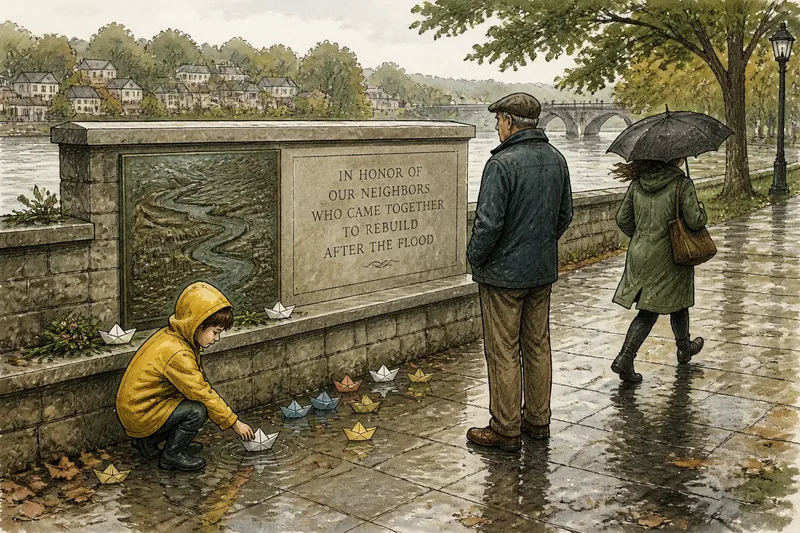
On a rainy afternoon, a child leaves a paper boat at the foot of a stone monument, while a passerby pauses to read the inscription and a neighbor hurries past without looking up. The monument has not changed, but its meaning is already doing more than one thing. To understand a meaningful monument, it helps to separate the message its makers intended from the uses it acquired later and the interpretations people bring to it now.
One invented monument enters public life
Imagine a town planning a memorial beside a riverside walking path. The project committee chooses a low stone wall, a bronze river-shaped relief, and an inscription honoring residents who helped rebuild the town after a flood. For the committee, the central message is mutual aid: people faced a shared danger and worked together.
The design does not say exactly what every visitor should feel. A broad ledge invites people to sit, the path makes the site part of a daily route, and the river image can suggest both danger and renewal. Those choices may support the intended message, but they also leave room for uses and readings the committee cannot fully specify.
For the imagined opening, the committee places the memorial near the path rather than behind a fence. It hopes that people will stop, read, and remember the rebuilding effort. That intention matters, but it is only the first layer of the monument’s public life.
The intended message is a starting point
To identify what a monument was meant to communicate, look for evidence in the object and its making. The inscription, imagery, location, dedication materials, and stated purpose can all help. In this invented case, the words about rebuilding and the river relief point toward collective recovery.
Intention is not the same as a complete meaning. A committee may have agreed on the main purpose while disagreeing about details, and the finished object may communicate more than its makers planned. A river carved in bronze might evoke a particular disaster for some residents and the ordinary beauty of the waterfront for others.
It is useful to state the intended message narrowly. “This memorial honors residents who helped rebuild after the flood” is more careful than “This monument represents the town.” The narrower description leaves room for the town’s other histories, experiences, and disagreements.
Later uses add a different layer
Now imagine that, over time, walkers begin leaving small paper boats at the wall during the rainy season. A local school brings students there to discuss how neighbors helped one another. On another occasion, residents gather at the site to call attention to a drainage problem they believe the town has neglected.
These later uses do not erase the committee’s original purpose. They show how people have made the site useful in new circumstances. The paper boats may connect the memorial to family stories of the flood; the school visit may turn it into a place for teaching; the gathering may use its public visibility to make a present-day claim.
None of those activities proves that the monument was designed to support every later message. Nor does a use become meaningless because it was not planned. A careful account distinguishes what the makers intended from what later visitors have done, without treating one layer as automatically more authentic than the others.
Viewers interpret the object from where they stand
A person approaching the invented memorial may have a family connection to the flood, may know nothing about it, or may have memories of being left out of the town’s official story. The same inscription can therefore feel honoring, incomplete, distant, or newly relevant. Those responses are interpretations shaped by experience, not simple errors to be corrected.
That does not mean every interpretation is equally supported by the object. A reading grounded in the inscription and the memorial’s documented purpose differs from a claim that ignores them. Still, evidence can clarify a disagreement without making every viewer arrive at one emotional response.
Consider a visitor who reads “our neighbors rebuilt together” and wonders whose labor the phrase leaves unnamed. That question does not automatically disprove the memorial’s message of cooperation. It asks who appears in the public wording, who may be absent, and how the phrase works for people encountering it now.
Keep the three layers distinct in conversation
When a disagreement arises, separate three questions before deciding what the monument means:
- Intended message: What did the makers say they wanted the monument to honor or communicate?
- Later uses: How have residents, institutions, or visitors used the site since it was created?
- Current interpretations: What do people read into the object, and what experiences or details shape those readings?
Say a town resident argues that the imagined river memorial is only about civic pride, while a student says it also raises questions about whose work was recognized. A useful next move is to point to the inscription and design for the intended message, describe the school visits and paper boats as later uses, then make room for the student’s interpretation as a present reading. That approach does not settle every dispute; it makes clear what kind of claim each person is making.
Be precise about what is known. If an inscription or public record explains the committee’s aim, describe that evidence. If the history of a later gathering is unclear, say so rather than turning a plausible story into settled fact. The distinction is especially helpful when public debate moves quickly from “this is what the monument says” to “this is what everyone must think it means.”
Questions readers ask about a monument’s meaning?
Does the creator’s intention decide what a monument means?
Intention helps explain the original purpose, especially when it is supported by an inscription or other public record. It does not settle every later use or viewer’s interpretation.
Can a monument have more than one meaning?
Yes. Its official message, its place in later public activity, and the meanings people bring to it can coexist, even when they conflict.
How can I tell a later use from an intended purpose?
Ask whether the action or reading appears in the makers’ stated purpose, or whether it emerged through later community activity. Describe the evidence for each separately instead of treating one as proof of the other.
What should I do when interpretations disagree?
Name the object’s documented message, describe its observable public uses, and listen for what viewers say the object brings to mind. Then discuss which claims are supported by evidence and which express a present-day response.
A public meaning remains open to discussion
In the invented riverside case, the memorial began as an acknowledgment of collective rebuilding, became a setting for school visits and neighborhood gatherings, and acquired personal meanings that differed among visitors. None of these layers has to cancel the others. They do, however, call for different kinds of evidence and more careful language.
When you next encounter a meaningful monument, begin with a modest question: what can I see, what can I document, and what is someone interpreting? That small pause helps keep the object’s original message, its changing public life, and the viewer’s response in view at the same time.